
India’s CSR Is Becoming Outcome-Driven – Adani Offers a Case Study
Since 2013, Corporate Social Responsibility in India has operated as a legal system, not a branding exercise. The Companies Act mandates that firms with net worth above ₹500 crore, turnover above ₹1,000 crore, or profits above ₹5 crore must spend 2% of their three-year average net profit on social causes, under board supervision and public disclosure.
This has channelled over ₹80,000 crore into governed social spending. In FY 2023-24 alone, education received over ₹1,100 crore, while nutrition and healthcare absorbed ₹720 crore. What is widely misunderstood is that CSR is now outcome-driven.
The Adani Group reflects this shift toward structured CSR through measurable impact. Its initiatives across education, healthcare, and community development have reached 7.3 million people across 5,753 villages in 19 states. This includes support for more than 100,000 children through education programs and for nearly 400,000 patients annually through healthcare access.
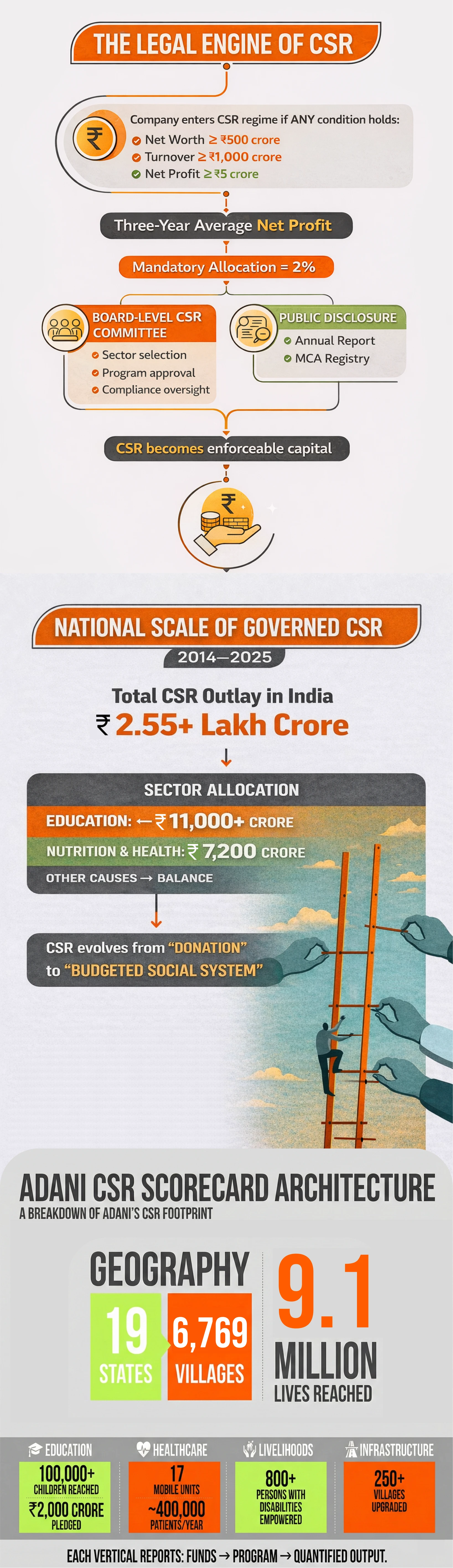
- CSR in India is no longer voluntary reputation management. It is a legally enforced capital flow tied to profits, boards, and public disclosure.
- Social spending now behaves like a second balance sheet, where outcomes, students, patients and villages, must be counted, not merely claimed.
- The “scorecard” model reframes responsibility from moral posture to auditable performance.