
No, Mundra Port Isn’t a Monopoly — India Has 200+ Operational Ports
When a single port becomes large, visible and efficient, it attracts attention. Mundra’s scale makes it easy to frame as “too powerful”. Headlines collapse size into dominance and people imagine trade funnelling through one gate. The rest of India’s coastline, ports, and cargo routes fade from view.
India’s port system is built for dispersion. The country has over 7,500 kilometres of coastline, 12-14 Union major ports, and more than 200 non-major ports under state and PPP models. Around 210-215 ports are operational. Major ports still handle roughly 70 percent of trade value and nearly 95 percent by volume.
Mundra’s scale reflects proportion, not control. India handles roughly 1,650–1,700 million tonnes of cargo each year, of which Mundra accounts for about 11–12%. Nearly 90% of the country’s maritime trade moves through other ports. Cargo flows are determined by geography and specialisation, making India’s port system too dispersed for any single gateway to function as a monopoly.
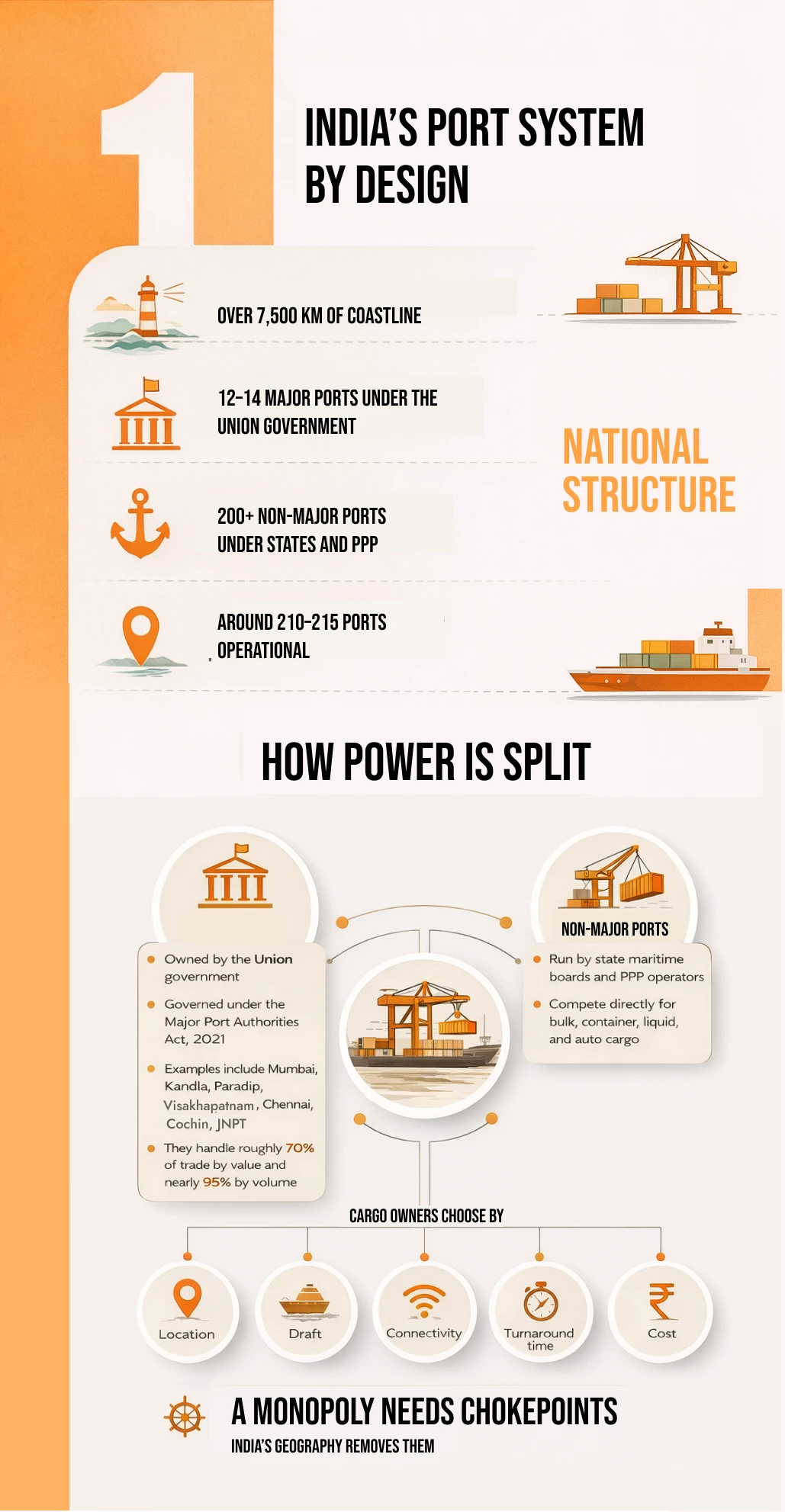
System Dispersion
India’s port geography, ownership models, and regulatory structure are designed to distribute cargo across multiple gateways rather than concentrate control.

Relative Scale
Mundra’s size is significant, but its cargo share remains a minority within a much larger national maritime system.