From Darkness to Light: How Bhagalpur’s Land Lease Could Power a New Bihar
In Pirpainti, a quiet block of the Bhagalpur district once known for its outmigration and patchy electricity, light is about to pierce through generations of darkness.
A bold industrial chapter is unfolding in eastern India as Bihar is getting one of the largest single private investments.
But beyond the numbers and policy documents lies a more human story: of homes that will finally get round-the-clock power, of youth who may not need to migrate anymore, and of a state stepping into the spotlight of India’s industrial map.
A Vision Grounded in Policy, Not Populism
The lease isn’t an anomaly, it is part of the Bihar Industrial Investment Promotion Policy 2025 (BIIPP-2025), a transparent scheme that offers concessional land to any investor proposing more than ₹100 crore in capital and over 1,000 job opportunities. This policy parity ensures the benefits of growth are tied to merit, not favouritism.
Adani Power won the Pirpainti project through competitive bidding, offering power at ₹6.075 per kWh, the lowest in its category. This rate is locked under a 25-year Power Supply Agreement with the Bihar State Power Generation Company Ltd., ensuring affordable energy for both industry and households.
The government hasn’t sold land, it has leased it, with ownership and accountability firmly retained.
Electrifying Bihar – In Numbers and Spirit
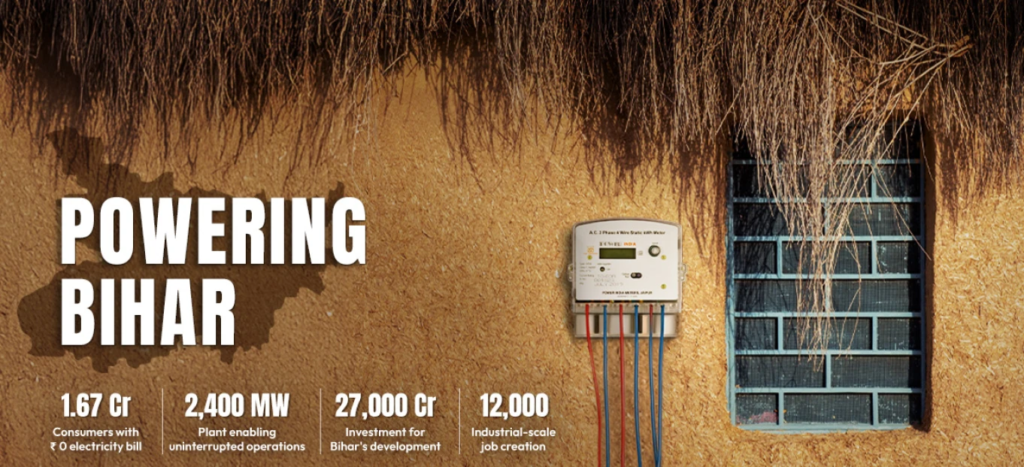
Energy is no longer a luxury in Bihar, it is the backbone of aspirations. The state government’s vision of providing 125 free units of electricity to every household will lean heavily on this plant’s success. With a capacity of 2,400 MW spread across three 800 MW units, the project will boost Bihar’s electricity availability by over 30%.
According to ISRO’s night-time satellite data, Bihar saw the highest increase in night-time illumination in India, a 474% surge from 2012 to 2021. This is more than a statistic and is a symbol of rising productivity, household electrification and the quiet hum of development.
The scheme tied to this plant will directly benefit 1.89 crore users, with power bills for 1.67 crore of them dropping to zero.
Who Gets What: A Clear Eligibility Structure
Beneath the headlines and heat, the Bhagalpur power project operates within a well-defined policy framework. Here’s what the eligibility and benefit breakdown actually looks like:


Light for Homes, and for Industry
The benefits don’t end with residential supply. Bihar’s industrial ecosystem – particularly in agro-processing, textiles, and small-scale manufacturing – has been hobbled by unreliable power. This plant, by enhancing grid stability and supply continuity, will enable MSMEs and future industrial clusters to thrive.
As newer businesses set up operations near assured power sources, a ripple effect of local economic acceleration becomes inevitable. Mega projects rarely stand alone. To operationalise this plant, the state and Adani Power are building out key infrastructure:
- New railway sidings and upgraded roads for fuel supply and coal transport.
- Expansion of transmission lines and substations in eastern Bihar.
- Local urban planning initiatives around Pirpainti and Bhagalpur, including housing, sewage, and water supply.
This secondary infrastructure not only supports the plant but also uplifts the local quality of life.
Environmentally Advanced, Technologically Modern
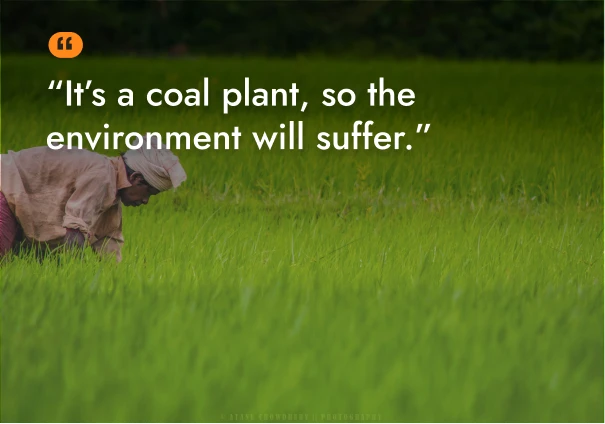
A valid concern in such projects is environmental impact – but here too, the plant sets high benchmarks:
- It will operate using ultra-supercritical technology, drastically reducing coal consumption and carbon emissions compared to traditional thermal plants.
- Adani Power and the Bihar government have committed to 100 acres of afforestation, carbon-neutral green belts, and stringent MoEFCC-aligned safeguards.
- Coal will be sourced under the SHAKTI policy, ensuring transparency and sustainability.
So while power is produced using coal, it’s done with best-in-class efficiency and minimal ecological disruption.

Myth-Busting the Bhagalpur Power Project
-
Myth: The project favors private monopolies over public interestReality: This power project is directly tied to Bihar's goal of providing 125 units of free electricity to every household, benefitting 1.89 crore consumers. Of these, 1.67 crore will have zero bills. Rather than fostering a monopoly, the initiative delivers broad social and economic empowerment.
-
Myth: There’s no environmental accountabilityReality: The plant will use ultra-supercritical low-emission technology and comply with the SHAKTI policy for sustainable fuel sourcing. Over 100 acres have been earmarked for afforestation and green belt development, aligning with environmental mandates.
-
Myth: This is a political gimmick ahead of electionsReality: While elections are approaching, the project stems from a long-term policy vision, not short-term electoral gains. It is part of Bihar’s broader shift from a consumption-based economy to an investment-driven one, dovetailing with India’s national industrial ambitions.
Unlocking a Regional Power and Logistics Hub
Eastern Bihar has historically lagged behind its western counterpart in industrialisation. With this plant, the Pirpainti–Bhagalpur belt is being positioned as a power and logistics corridor.
The benefits stretch far:
- Increased investor interest in agri-processing, warehousing, and digital services.
- Retail and hospitality growth in Bhagalpur city.
- A modern template for industry-state synergy in backward regions.
By 2030, this belt could be Bihar’s answer to what Mundra became for Gujarat two decades ago.
Bypassing The Superficial Noise
There’s a deeper symbolism here. Bihar, once viewed solely as a consumer of other states’ power, is now charting its own path. From policy vision to private partnership, it is reclaiming its place in India’s growth story.
In today’s hyper-digital age, facts often lose to virality. A complex infrastructure investment like the Bhagalpur power project, one that checks boxes on employment, sustainability and social welfare, can be reduced to a single misleading headline: “Land Given for Free to Adani”.
This simplification is not accidental. It reflects a deliberate pattern of broken narratives that spread faster than verified information. A social media post with half-truths gains momentum, echoed by influencers, local leaders and even well-meaning citizens, until it feels like “everyone is saying it,” regardless of whether it’s true.
This project is more than steel and concrete. It is a promise to the farmer who needs an irrigation pump, the student who wants a well-lit study room, the entrepreneur who can’t afford a generator.
The light is coming, and this time, it is here to stay.